
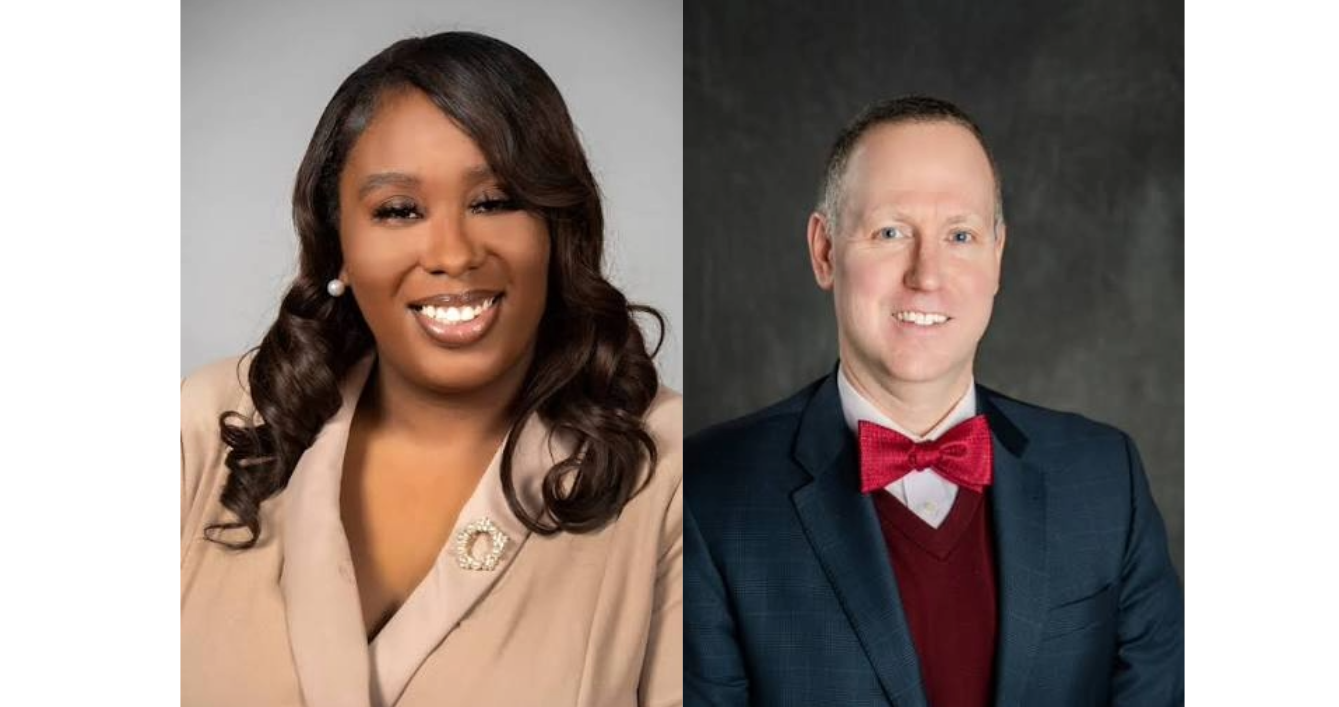
Discussing Effective Lawmaking with Ohio Senator Louis Blessing III and Representative Latyna Humphrey
On October 19, 2026, The Center for Effective Lawmaking partnered with The Ohio State University’s Institute for Democratic Engagement and Accountability (IDEA) to co-host a panel featuring Representative Latyna Humphrey and Senator Louis Blessing III of the Ohio General Assembly. The conversation explored the legislators’ approaches to the lawmaking process, the practices and strategies that have contributed to their lawmaking effectiveness, and their broader experiences while serving in the Ohio General Assembly. Representative Humphrey and Senator Blessing also responded to questions from student audience members, creating an engaging dialogue about what effective lawmaking looks like, in practice.
Representative Latyna Humphrey is a proud Columbus native and a graduate of Columbus East High School, Columbus State Community College, and Franklin University. Representative Humphrey joined the Ohio House of Representatives in 2021 after being appointed to serve the remainder of former Rep. Erica Crawley’s term. She has been representing Ohio House District 2 since 2023. During her time in the House, her major legislative priorities have been affordable healthcare, criminal justice reform, workforce development, housing access, and childcare affordability. In addition, she serves on the House Community Revitalization, Energy, Government Oversight, and Public Safety committees. Outside of the legislature, Representative Humphrey is a two-time published author, nationally renowned speaker, and community organizer. For her work in the legislature, she has been recognized as the Myrl Shoemaker Legislator of the Year, and a recipient of the Next Up Columbus Award.
Senator Louis Blessing III is a proud Cincinnati native and a University of Cincinnati graduate with bachelor’s degrees in mathematics and electrical engineering. Senator Blessing previously served in the Ohio House of Representatives from 2013 to 2019 before moving to the Senate, where he represents Ohio’s 8th Senate District. Senator Blessing has assumed prominent Senate leadership roles in the 136th General Assembly, where he serves as Chairman of the Senate Ways & Means Committee and Vice Chair of the Senate Education Committee; he also serves on the Finance Committee, the Financial Institutions, Insurance and Technology Committee, and the Judiciary Committee. Senator Blessing is a licensed professional engineer and a member of the Ohio Society of Professional Engineers.
Both Representative Humphrey and Senator Blessing were among the CEL’s top-10 most effective lawmaker list in their respective parties and chambers for the 2023-2024 legislative sessions.
On advocating for laws based on constituents’ needs:
Representative Humphrey: “Because I have the poorest house district in Franklin County, number one in infant mortality, number one in rental evictions. The list goes on. So, when I introduce legislation, it’s not willy-nilly pieces of legislation. It’s legislation that’s going to help people. When we talk about public safety, how do we keep communities safe? Well, a part of that is making sure that folks who are returning from incarceration have the support that they need to continue to be or try to be successful, so they don’t do what? So, they don’t recidivize, and [I] pass a number of legislation as it relates to reentry and returning citizens. And as I mentioned, infant mortality. So, I say all that to say, for me specifically, is what can I do to actually help people in the time being and get it across the aisle?” [Advocating for laws based on constituent and district needs connects with our five habits of highly effective lawmakers ]
On the importance of galvanizing grassroots support and encouraging bipartisan progress:
Senator Blessing: “But that’s not to say that solid reform cannot be done or cannot be accomplished through the natural order of business. I can tell you being on judiciary committee, and I think this ultimately wound up in one of Rep Humphrey’s bills, the license suspension reform, that was a masterclass of bipartisanship. If you look at that, that was Senate Bill 36, last General Assembly. And what it did was try to transform the idea that people would get a suspended license, they’d lose their ability to drive, then they would get worse. The fines would ratchet up when they would try to drive with a suspended license. And that was a problem. And so, what you had was you had groups like the Ohio Poverty Law Center, the ACLU Justice Action Network locking arms with Ohioans for Tax Reform, that’s Grover Norquist’s Group, or Americans for Tax Reform, Grover Norquist’s Group, Americans for Prosperity, the Ohio Chamber. Suddenly, there were folks that were like, “Well, we don’t like this because it seems like it’s letting people off the hook,” but it just became too great of a bipartisan coalition that it couldn’t be opposed for much longer.” [Galvanizing grassroots support and encouraging bipartisanship progress coincides with our ENGAGE mnemonic found in the CEL’s State New Member Guide]
On the importance of bipartisanship:
Representative Humphrey: “Now, what I found was, is who I know I can work with. At the time, as it related to criminal justice reform, it was Bill Seitz. If I wanted to focus on infant mortality, it was Andrea White. If I wanted to focus on, there’s a small business bill now that I have with Representative Jennifer Gross. We are on two polar opposite sides of the political spectrum, but we introduced a bill, passed it nearly unanimously, and now it’s in the Senate.” [The importance of bipartisanship for effective lawmaking is emphasized in our research ].
On being entrepreneurial with positions of institutional power:
Senator Blessing: “You can change the course of public opinion on a certain piece of legislation or policy idea bringing up what is really going on….And honestly, nine times out of ten, it feels like some big monied interest wants a carve out, they want a tax credit, they want immunity from whatever, and they’ll try to sneak it in there as some sort of great thing for the public when it’s really garbage. And members being able to be on the right committees to be able to bring that up with their voice. Same thing with the Senate floor and the House floor, to bring it up and make it as painful for special interest as possible if they’re doing something really untoward in terms of getting legislation through, that matters a lot. And so, for members to be on the right committees, yes, it matters. [Being entrepreneurial with positions of institutional power coincides with our five habits of highly effective lawmaking]
On the importance of building relationships and cultivating a broad set of allies:
Representative Humphrey: “I go into the state legislature very intentional because of what’s at stake by what I see in my district….So I learn, who do you work with? And the other thing is, I’m not saying that I’m a go along, get along, [person] but I’m very intentional on sealing a deal, getting the sale, getting a bill on the governor’s desk. I don’t go in there trying to make everybody my enemy.” [The importance of building relationships and cultivating a broad set of allies is highlighted the CEL’s State New Member Guide and five habits of highly effective lawmakers]
Michael Neblo (00:03:58)
Okay, let’s get started. Good afternoon and welcome. My name is Michael Neblo from the political science department here at Ohio State, but I’m here today in my role as director of IDEA, the Institute for Democratic Engagement and Accountability. Thanks to the audience for coming and especially to our honored guests, Representative Latyna Humphrey and Senator Louis Blessing. Thank you so much for taking the time to be with us today. Legislators get more invitations than they have afternoons and we appreciate you spending this one with our students in the OSU community to talk about your work on behalf of Ohio. Thanks, as well to our colleagues in the Office of Government Affairs, Carly made it over here, who offered essential support organizing the program to the Ohio Union staff. We gave a late tech curve ball here and it’s been handled very, very smoothly, so thank you.
And to the IDEA team, above all, Adam Duffy who did the heavy lifting for this event. Adam’s not in the room, but I want to extend him my thanks. A quick word about IDEA for those of you who are new to our work, for nearly 20 years, my colleagues and staff and I have been running what we call deliberative town hall. So, we bring ordinary citizens together with the officials who represent them, members of Congress, state legislators, local officials, and legislators outside of the United States to talk through difficult issues and we study what happens, but we use a random sample of constituents because any of you who have done constituent events know who shows up. You got usual suspects showing up and they’re great. They’re good citizens. They’re taking time out of their day, but they don’t necessarily represent your constituency very, very broadly.
So, we tried to reach beyond that a little bit to provide some information and a supportive structure for those sorts of connections. We’ve done this across the United States and in half a dozen other countries and the findings are very consistent. When representatives engage citizens directly and explain their reasoning, people come away knowing more, trusting more and participating more down the line, including many who walked in the door are very skeptical. But explaining yourself is only half of accountability. The other half is delivering. A representative who listens well and then gets nothing done has kept only half of the bargain. IDEA studies the first half, what happens when lawmakers engage the people they serve? My friends and colleagues in the discipline, Craig Volden and Alan Wiseman from the Center for Effective Lawmaking study the second half, which lawmakers actually move legislation through and how? Put the two together and you have the full circuit of representation.
Citizens speak, representatives answer, representatives deliver, citizens judge. We also share something else between our two centers. Both IDEA and the CEL began as basic research. They didn’t start as public facing projects. We were scholars asking questions because the questions were open and seemed important to us, not because anyone had commissioned the answers and both remain rooted there. We’re both still committed to basic research, but its basic research pointed at a practical end, shovel ready, if you will, to make democracy better by helping us understand democracy well enough to improve it because you can’t fix what you don’t understand. Craig Volden is professor of public policy and politics at the University of Virginia with appointments in the Frank Batten School of Leadership and Public Policy and the Department of Politics. He’s the co-founder and co-director of the Center for Effective Lawmaking and served four years as the Batten School’s Associate Dean for Academic Affairs and then as its interim Dean.
Before Virginia, Craig was on the faculty here at Ohio State, which is where, well, it’s not where I met him initially, but we met at that school up north when we were on a postdoc. I’ve learned to say that. You guys are freed from the obligation there on a postdoc. But when we moved down here to Columbus, Craig lived about four doors down from me in Victorian Village. He helped me put a new bed together the night before my first daughter was born so that my wife had more than a basic frame to bring our baby home to. He was and is that kind of friend. Alan Wiseman is the Cornelius Vanderbilt professor of political economy at Vanderbilt University, professor of political science and law and associate provost. He has chaired Vanderbilt’s political science department. And before Vanderbilt, Alan too was on the faculty here at Ohio State where he directed the undergraduate public policy minor.
Interestingly, Alan also lived on the same street that Craig and I did, a little bit further down. The day my wife and I moved into our house, we walked down the street to attend a 4th of July party at Alan’s house, our first day in Columbus. The three of us all trained for a marathon during the first months at OSU. And my wife enjoyed Alan’s company so much, I think sometimes more than mine, that they would hang out together without me, which is an understandable choice for both of you. Craig and Alan co-authored Legislative Effectiveness in the United States Congress: The Lawmakers, which won the American Political Science Association’s Feno Prize and the Kammerer Award. In 2017, they founded the Center for Effective Lawmaking as a joint venture of Virginia and Vanderbilt. The center produces the legislative effectiveness scores, a measure for every member of Congress since the 1970s and now for state legislators across the country, a measure of who actually gets bills moved through the process.
Scholars, journalists, and legislators themselves now use those scores to ask who gets things done and how. The idea that grew into legislative effectiveness, it came out of conversations Craig and Alan had when they were here at Ohio State. I was telling them that I had this vivid memory this morning of one of their early meetings stepping out, just one of those snippets that you get sometimes. So today is a kind of homecoming and welcome back.
Craig and Alan were my colleagues then and they’ve been my friends ever since. I can’t think of two people I’d rather have lead this conversation today and for our democracy over the coming years. Please join me in welcoming Craig Volden and Alan Wiseman.
Alan Wiseman (00:10:56):
Great. Well, thank you so much for that kind introduction, Mike. Yeah, there’s some great memories training for the marathon and horrible pain in my feet and knees and every other part of my body, but that’s okay. It was a while ago. Well, as Mike said, my name’s Alan Wiseman and I’m professor of political science at Vanderbilt University. And along with Craig Volden, who’s on the other side there at the Frank Batten School of Leadership and Public Policy at the University of Virginia, I co-direct the Center for Effective Lawmaking. So, as Mike alluded to, the Center for Effective Lawmaking is a joint research education and outreach initiative between Vanderbilt University and the Frank Batten School of Leadership and Public Policy at the University of Virginia. The center was created in 2017 and formally speaking, we seek to advance the generation, communication and use of new knowledge about the effectiveness of individual lawmakers in US-based legislative institutions.
So, to that end, we’re excited and really delighted to be back at the Ohio State University where both of us taught earlier in our career and to be in partnership with the Institute for Democratic Engagement and Accountability and speaking more on mission with the things that the center does, we’re just thrilled today to have the opportunity to engage with two distinguished lawmakers from the Ohio State General Assembly. So, first to my right, we’re grateful to have the opportunity to welcome Representative Latyna Humphrey, a proud Columbus native who is a graduate of… We can applaud, that’s good, is a graduate of Columbus East High School, Columbus State Community College and Franklin University where she studied applied psychology. Representative Humphrey has served in the Ohio House of Representatives since 2021 when she was appointed to complete a partial term representing District 26, which for those of you from the area know that comprises parts of Bexley, Columbus, Groveport, Reynoldsburg, and Whitehall, when Representative Erica Crawley stepped down to become Franklin County Commissioner, and she’s been representing House District two since 2023 where she’s advocated for affordable healthcare and the expansion of affordable housing to low income Ohioans as well as advancing criminal justice reforms.
Now zooming in, we are especially grateful to see Senator Louis Blessing via Zoom, a proud Cincinnati native who’s a graduate of the University of Cincinnati where he earned his bachelor’s degrees in mathematics and electrical engineering. Senator Blessing previously served in the Ohio State House of Representatives from 2013 to 2019 before moving on to the Senate where he currently represents the eighth Ohio Senate District, which comprises a portion of Hamilton County. Senator Blessing has assumed prominent Senate leadership positions in the 136th General Assembly where he serves as chair of the Senate Ways and Means Committee and Vice Chair of the Senate Education Committee, and he also sits on the Finance Committee, the Financial Institutions Insurance and Technology Committee and the Judiciary Committee. So, we’re really excited to hear from Representative Humphrey and Senator Blessing about their perspectives on how to be effective lawmakers in the Ohio General Assembly and in contemporary times more generally speaking.
So Representative Humphrey, Senator Blessing, thanks so much to the both of you for taking sometime today. As Mike noted, we know that you get a ton of invitations and demands in your time and finding an hour to an hour and a half to spend with us is really valuable both for our missions as centers and having the opportunity to engage with the students both here and those who will be viewing the recording later. We plan on leaving ample time for many students in the audience to ask some questions if they’re interested, but first we’ll be asking both of you a series of fairly general questions about your backgrounds and your perspectives on the legislative process and would really welcome you to provide us with some specific examples from your own careers to help provide some background and context for some of your responses to these questions.
So, thank you both.
Senator Blessing (00:14:56):
Yeah.
Alan Wiseman (00:14:58):
Great. So, the first question I have for both of you, and I’m going to start with Representative Humphrey, is we want to just take a step back and start with some questions about how your background, and by that, I mean before you actually entered legislative office, shaped your approach to lawmaking. So Representative Humphrey, how did your experience essentially growing up studying and working in the community influence your decision to run for a seat in the Ohio State House of Representatives and what were you hoping to accomplish most once you were elected?
Representative Humphrey (00:15:28)Hum:
Thank you. Thank you for the question. I don’t know, I’m super excited to answer this question. I’ve always loved community and I’ve always loved history. I love documentaries. I love reading all the things and I just got this love for politics essentially. I had a political science class at OSU Newark at the time, and that’s really when I fell in love with it. Now mind you, I put a pin there to say I’ve always loved history, but when I attended Ohio State Newark, there was this professor, I’ll never forget his name, but his name is Professor William T. Dower. I mean, he just did a wonderful job. It made me fall in love with politics. And then from then I just remember studying leaders and representation is so important. So, I studied Senator Carol Mosley Brown, Congresswoman Beatty, Shannon Harden, all the things. I literally just kind of fell in love with it.
But at the time I was working, I feel like when I fell in love with it, I was working in banking at PNC in Newark. So, I’m from Columbus, lots of times I’ve always worked in Columbus, but I did work at a bank in Newark. And so, I was working in banking and studying while I was working. I should have been focusing on being a bank teller or whatever, but I was watching documentaries when it was slow and all the things and I just kind of fell in love with politics, but it took me a while to actually get involved. I think my son is here, he was about maybe about one or two around the time that I fell in love with it. And then a few years later, as I was transitioning from being a bank teller to being a collector, I used to call people and say, “Hey, pay a bill, et cetera, et cetera, for the banks.” But anyway, I made up my mind like, “You know what?
I want to serve.” How do you put yourself in a position of service? Again, you study other leaders and I did that. I mean, anything I could do to put myself in position, I really did it. I tried to save as much money as I could, just all the things so that way when the time was right, I would be able to kind of make it happen. So, my background is unique. It’s not the traditional background. It took me seven years to get an associate’s degree, even longer to get a bachelor’s degree. And I say all that to say, my journey was different because I knew that I didn’t have what everybody else had. So because it took me so long, I started volunteering with the Franklin County Democratic Party, even living in Lincoln County, helping with the Lincoln County Democratic Party, volunteering at the YMCA, volunteering at the YWCA, just so that I could get the experience because I understood that because of my background and because I was non-traditional, had my son at 19, all the things, I knew I had to do something different to get the experience that other people had.
And what I found out later down the line, my lived experience and the work that I did during the time really uniquely positioned me to be a state representative. So, I fast forward to all that. I got involved with the Franklin County Young Dems. Fast forward past that; I got involved with the Central Ohio Young Black Dems. I was secretary for a bit, and then I became president of the Young Black Dems, and then I got jobs with different elected officials. I worked for Michael Stenziano here, Franklin County auditor. Fast forward, I worked for the Honorable Judge Carl Alvaney in a court of common pleas. That’s where my love for criminal justice came from. And then the vacancy to Ohio’s 26th House District opened up. And because of my experience, because of what I learned, because of my engagement in the community, when that appointment opened up, I did not have the support at the time, but because I had the lived experience, because I did the work, because I really made my team with the Central Ohio Young Black Dems really get involved in community when the position opened up and when I went to interview against 11 people, I was chosen and I was not…
When you’re appointed, somebody is already selected. I skipped that whole process, if I’m being honest, and they chose me against whatever was suggested by my predecessor, you understand? So, I say all that to say, all of that developed me to become a state representative. And I think to the second part of your question, which I was talking to myself about while I was working out a couple days ago, and I was like, when I came into the state house, I knew that it was going to be tough and I had no idea that I would be as successful as I have been. I knew that it was going to be tough, so I was going to focus on community engagement. How can I connect people to resources? How can I stand up for people? I mean, I’m spiritual, so I say God blew my mind so that way I started introducing bills and then getting support from across the aisle, and before you know it, it’s on the governor’s desk and it all happened so fast.
And I’m like, “My God, how did I get here?” But I would say all of my lived experience, having to work in banking, having to work with people, I worked at Bath & Body Works for six years as a sales associate and learning how to sell, because for me, that’s what it feels like, learning how to engage with people. How can I get this person to buy X, Y, and Z and then say my name that told them or recommended them or referred them to buy this product so I can seal the deal? How can I do that? I say all of my lived experience as a mom, as a sales associate, as a bank teller positioned me to be a successful legislator. So, thank you for the question.
Alan Wiseman (00:21:32):
No, thanks for that. Yeah, we could have come on applause, so that’s great. So, Senator Blessing, turning to you in a similar vein, I’d really like to hear your perspectives on how your experience as a professional engineer, which doesn’t obviously have natural ties to the political environment, how did that influence your decision to run for office? And likewise, what were the types of problems that you were encountering or what were the types of goals that you want to engage with upon being elected?
Senator Blessing (00:22:00):
Yeah, so very briefly, I think you nailed it when you said it doesn’t directly tie into what you do as a legislator. And I would tell folks that being a professional engineer really hasn’t done much of anything in terms of the legislative process, except being numerate has been very valuable, particularly in a lot of the areas that I work in, particularly taxation and financial matters. But it really didn’t have much influence on me running other than maybe a year or two prior to being elected, I had actually received my professional engineering license. So perhaps there was some degree of I did that, I accomplished that life goal, and really the bigger factor is my father was retiring and he was a long-time legislator for 30 years. He was in the house, the Senate and the House again from 1983 into 2012. And as you know with politics, name ID makes a big difference.
We have the same name. He’s Louis W. Blessing Jr. I’m Louis W. Blessing III. And politics being what it is, you see that all the time where people will run and a lot of times an opportunity like that outside of name ID doesn’t turn up very often. The opportunity presented itself. I had followed politics for many, many years. I had worked on a couple of dad’s campaigns, and I had known how it worked. So that was my opportunity to jump in. I did it. And thankfully I had the backing of the late former speaker William Batchelder, which was very important because even my own party chair was telling me, “You might want to sit this out and get a little bit of experience before you run.” He was having none of it and said, “Look, that’s nice that your local party chair said that, but we want you to be running.” So, I ran, I won.
And just very briefly, where I’ve started in the legislature and where I ended up now, I think it’s very important when Representative Humphrey talks about lived experience. For my part, being in the legislature and seeing how things that we do impact people and taking a step back and looking at the philosophy of a lot of this, that lived experience, even though that lived experience has been in office, has shaped a lot of where I’ve gone with legislation. So, in my early days, you would’ve seen a very libertarian streak towards what I do or what I’ve done legislatively, although there were fits and starts where I would buck leadership on various things, but by and large, libertarian oriented. Then over time, and I don’t know if this is a matter of just a combination of things, getting married, having children, I have three boys, as well as going through the pandemic and talking to frankly, organizations and people that I wouldn’t have normally spoken with in my world outside of politics started to craft, I guess I would say a different vision for where I wanted to be politically and what I wanted to see done legislatively.
So, you probably don’t see very many Republicans pushing for things like paid family medical leave, going after the large institutional housing investors by taxing them out of business. You wouldn’t normally see a legislator on the Republican side trying to do things like consensus voting or things like SJR2, which is making it easier to pass things at the ballot statewide. But what I have seen through a lot of this is that my heroes early on in their sort of platforms really didn’t fit with where I felt we are today. And so, at one time I might’ve been like, “Hey, Ron Paul is somebody who, great libertarian guy, seems to have the right attitude for a number of things.” These days, I find myself more and more looking at what former Supreme Court Justice Louis Brandeis would do, which I need to get a WWLB, what would Louis Brandeis do, little plaque for my office.
And then people will think I’m being arrogant referring to my father and I’ll be like, “No, it’s actually Louis Brandeis, have the same initials.” But when he was on the Supreme Court and even before, he was fighting the issues of the gilded age and then the progressive era, and a lot of these things that I think we’ve lost touch with in the race to just being more individualistic, we need to be looking more towards strengthening the community and public goods and things like that, which is why I was very pleased, I can’t remember who it was, was announced as a professor of political economy. And I love to hear that phrase, political economy because that used to be what the study of economics was, was political economy and it’s been lost now and it’s been sort of confused with, well, economics means whatever the business community wants.
And I’m like, “Ooh, it’s not working out so well these days guys.” And there’s a reason why Adam Smith had some issues with the business community, or should I say suspicions? But by and large, a lot of what I’ve seen has changed and shaped my opinion to where I am today.
Craig Volden (00:28:17):
Really appreciate that and thanks. Let me add my thanks to both of you for your public service and for your time with us today. I want to pick up now thinking about the early days when you were first in the general assembly, how that went, how that evolved over time, what you wish you were told then that you know now and so on. And starting with you, Representative Humphrey, just thrown into the mix midterm. Tell us about those experiences and did they tell you what you were going to experience as you were heading in? What should they have told you about lawmaking?
Representative Humphrey (00:29:00):
Thank you for the question and I’m going to be really transparent because I appreciate the question, but I feel like my experience was a little bit different. So, I’ll go back to what I mentioned before. I thought I knew what I was getting into going to the legislature. I’m like, okay, with all due respect, its Republican control, maybe a little chaotic, et cetera, et cetera. So, I’ll focus on how can I partner with certain organizations, et cetera, et cetera, all of that. And then I had certain legislators in my party say, “Listen, you just got appointed. You really need to focus on getting reelected.” And so, I wouldn’t focus so much on legislation. Now, I don’t know what it is about me, but I don’t like being told what to do. And that sounds bad, but I’ll be honest. So, they’re like, “Don’t worry about that.” I’m like, “Well, I at least want to see.
I want to try it out. That’s what I’m here for. I mean, even if it stalls, I have a responsibility to try.” And so, I introduced a parole board bill with Brian Stewart.
I was appointed, so it was already late in the term, which meant it was never going to go anywhere. And that was one thing. And then I introduced a bill that would reimburse… Oh my God, what did the bill do? My God, y’all, I’m sorry. It’s been a minute. It was campaign funds for childcare. As you guys know, you can pay for childcare with campaign funds in Congress, and then you can do the same in some other states. We don’t quite have that in the state of Ohio. So, I introduced a bill and I put it out there and I asked for co-sponsors. And when I asked for co-sponsors, I seen, and this became my mentor on the Republican side, but became my mentor. But anyway, I introduced a bill. I got a bunch of co-sponsors, but I see one person on there on the other side, and it was William J. Sietz, Bill Sietz out of Cincinnati. And I said, “Ooh.” So, I said, “Okay.” And I thought, I said, “Well, you know what? Let me call him. Let me call him and see if he’s willing to not just be a co-sponsor, honey, be a joint sponsor.” And so, I had my office call and they said, “Well, give him a few minutes, probably like five, 10 minutes.” He told his staff, “Yeah, I’ll go ahead and be a joint sponsor.” And so, from there, and the bill actually got a few hearings unlike the parole board bill, even though that’s now signed into law as of a few weeks ago. But anyway, that bill, it moved quite quickly because honestly, because I had Bill Sietz on the bill. And when that happened, I developed a relationship with him. And I tell people all the time, I like to be open and honest about it.
Once I built a relationship with him, the floodgates opened and it helped me to build relationships with my other colleagues across the aisle. So, when we say, what did I wish I know then that I know now, I mean, I feel like I was divinely led, honestly. So, it was like, I can’t really answer that question in that way, but I was, I would say kind of lucky in a sense. I didn’t have the same… I know some of my colleagues might have had the, oh my God, I wish I knew then what I knew now, but because things happened so quickly, I just learned how to legislate early on. And so yeah, that’s kind of the story with that. That was the starting point.
Craig Volden (00:33:03):
Thank you. And Senator Blessing, sort of a similar question in terms of what you wish you knew then, but from your perspective, so what had you thought based on family experiences, based on having heard some earlier stories and so on, what were your perceptions of what your life was going to be in the General Assembly? And then did those come true or did you find things a little different?
Senator Blessing (00:33:34):
So let me just piggyback off of Rep Humphrey yet again, but I will say it in a little more crass way. I don’t believe that anybody can really be fully prepared for the General Assembly, despite all of the rhetoric that I knew exactly what I was going to do on day one and exactly how I was going to do it, blah, blah, blah. No, you didn’t. You absolutely did not. Any legislator that says that is fooling themselves. You really do have to spend some time getting your bearings, understanding how things work, working with the legislative service commission, working with other members. These are all things that are going to take time, and experience is frankly quite good in this. And even the smartest people can just hop in there and struggle simply because they’re just not used to working in that environment. Now, in terms of things that I wish I would’ve done differently, that’s a tough question to ask because so much of this is tied to elections and so much of our elections are tied to money that I’ve fundamentally felt there are two paths, maybe three paths you can take in the general assembly.
One, you can just kind of be a backbencher. There’s a number of legislators, I won’t name names that do that, that just are just happy to be a legislator. They’ll introduce lobbyist driven bills here and there, but by and large, they don’t rock the boat. Then you have people who are like the captains of a party and they’re often introducing legislation that frankly the party wants. They tend to be really good fundraisers, but oftentimes their best ability is heaving unpopular ideas over the finish line in an effective manner. That will get them to move up into leadership and potentially the other chamber or maybe Congress. But if you can do that in today’s framework in the legislature, that will help you. The third path and where I have gone lately, and I can’t describe where I would’ve been before, is what I call the sincere reformer.
And this touches on a little bit what you guys were talking about before, trying to measure legislative effectiveness, and I’ll get into that in a moment. But when I say sincere reformer, I mean people that actually get into the weeds and try to solve things on behalf of their constituents, on behalf of the people of Ohio at large, even if said solutions and legislative proposals, you name it, don’t have strong lobbyist backing or things like that. And that is really, really hard to do. And I have a lot of respect for members that do that, that say, “Look, I have an idea. I think this will fix it. I’ve read a lot of literature in the economics world to say that it will work. Yeah, this is great. I’m going to go down this path.” For me, a good example of that is passing, or not passing, but introducing legislation that would put on the ballot the enablement of land value taxes in Ohio.
You can look up and talk to any professor of economics, and they’ll tell you that land value taxation is a tremendous idea, but it’s prohibited in our constitution. Nobody tries it. And yet you’d bring it up to people, they’re like, “Well, who’s going to support it?” And my response is, “Why does somebody have to support it to introduce something?” And that’s what sincere reformers do. They take a good idea, and they put it out there, which gets me, I guess, to my final point here. What is an effective legislator? You could see members, and I’ve seen this in the past where they brag about the number of bills that they passed and I’m like, “Half of your bills are road naming bills or rare disease day bills or really small nibbling around the edge bills that aren’t really in any way, shape or form transformative.” Meanwhile, it’s also disingenuous to say, “Well, if you’re going to measure legislative effectiveness,” and I’m not saying you guys are, you have plenty of capable Democrats that are never ever going to get anywhere near the volume of legislation across the finish line as Republicans simply because they’re in the minority.
And at the same time, these really sincere transformative ideas that have tremendous polling advantages, massive backing from the economics community and academia, and yet because they inconvenience a large moneyed interest, they never go anywhere. But people pushing them, that doesn’t make them any less of an effective legislator. They’re trying to solve real problems, fighting real moneyed interest and real nasty gatekeepers. Because it doesn’t get across the finish line, to my way of thinking, does not make them an effective legislator. It means to me that they’re actually doing their job. And so, you don’t see as many legislators like that because it’s really risky to do that. You have to raise money to win campaigns. You have to worry about primaries. Raising money obviously is a big deal. Most members hate it and some unfortunately like it. I don’t know why, but you spend too much time doing that.
And to be a sincere reformer means that you’re probably going to alienate your own party, but you’re also going to find yourself in a weird situation with the opposition party where oftentimes they’re like, “Okay, is this person actually sincere in what he’s trying to do?” I will tell you with my legislation to go after the large institutional housing investors, when I first introduced that with Senator Antonio, a Democrat from Cleveland, this would’ve been three general assembly’s ago, I think. No, it would’ve been early March ‘23 is when we had our first hearing on it. So, I guess we’re getting at ‘23, ‘24. No, two general assemblies. And the first thought from some of the Democratic staffers was, “What’s he running for? Why does he want to do this?” And I kind of chuckled because I’m like, “Maybe because I have a real problem with large institutional housing investors.” At the time it was Finebrook buying up all these single-family homes in my district.
I hated it. I still hate it. I still think it’s awful. And I think over time, doing things like that helped me in my relationship with the Democrats, but it didn’t really endear me much to my own party until President Trump tweeted that he wanted to do it. And then all of a sudden everybody was like, “Oh, well, let’s introduce companion legislation in the House. Let’s do this, that, and whatever.” And I’m like, “Did you really need the president to come out and tweet something for you to do that? You could have just introduced it on your own because you knew, at least if you had thought about it, that it was a good idea.” And so, for me, knowing what I know now, I wish I would’ve been more of that risk taker right out of the gate. Would that have meant that I might not have made the Senate?
That could be the case because I wasn’t as vocal back then, but you only have so much time in the legislature and I don’t want to have any regrets when I leave. I want to be able to say that I pushed every piece of legislation for the public good that I possibly could in the time that I was given.
Alan Wiseman (00:41:56):
Thanks so much for that, Senator. I really especially appreciate the typology of legislators that you’re laying out and the different considerations. And that actually hits on a lot of themes that Craig and I have explored in our own work. And actually, I want to pick up some of the points you’re raising and turn it back to Representative Humphrey. So, you’re describing how when you first got into the House, you really had this incredibly valuable experience tied to your relationship with the Representative Sietz. And I’d be curious to know, especially given the points that the Senator was raising regarding how difficult it is when you’re in the minority party to push for meaningful policy change, how, if at all, has your approach to lawmaking evolved since that first term such that you’re able to be so successful given that you’re in the minority party especially?
Representative Humphrey (00:42:48):
Yeah. So, a lot of thoughts, because Senator Blessing is absolutely correct. And when he was listening to type of legislators, I knew where I fell, if I’m being honest. And I’ll tell you very candidly, because I know my district’s makeup and because I know my soon to be Senate districts makeup, I’m going to be very honest. I really don’t introduce legislation that I don’t think can get passed. Now, why do I do that? Because I have the poorest house district in Franklin County, number one in infant mortality, number one in rental evictions. The list goes on. So, when I introduce legislation, it’s not willy-nilly pieces of legislation. It’s legislation that’s going to help people. When we talk about public safety, how do we keep communities safe? Well, a part of that is making sure that folks who are returning from incarceration have the supports that they need to continue to be or try to be successful, so they don’t do what?
So, they don’t recidivize, pass a number of legislation as it relates to reentry and returning citizens. And as I mentioned, infant mortality. So, I say all that to say, for me specifically, is what can I do to actually help people in the time being and get it across the aisle? And I have a mentor of mine, his name is Larry Price, he’s senior advisor to our mayor here in Columbus. I remember we were having a conversation a number of years ago and he said, and I think it kind of ties into what Senator Blessing said just a little bit, but he said, “Listen, when I was a representative, I would just introduce the pieces of legislation as part of my job, et cetera, et cetera.” And I understood that. And a part of it kind of convicted me a little bit because I’m like, and I thought, like Senator Blessing said, we’re all different types of legislators.
And because I know my end goal and I know who I’m trying to help, and I know the people who call my office, hit my DM on Instagram, who reach out to me on threads, et cetera, I need to be intentional in what it is that I’m doing. Now again, I’m not trying to be willy-nilly, throw anything against the wall, see what sticks. No, what I found was is who I know I can work with. At the time, as it related to criminal justice reform, it was Bill Seitz. If I wanted to focus on infant mortality, it was Andrea White. If I wanted to focus on, there’s a small business bill now that I have with Representative Jennifer Gross. We are on two polar opposite sides of the political spectrum, but we introduced a bill, passed it nearly unanimously, and now it’s in the Senate, had multiple hearings, a bill to help folks be able to prepare food from their homes safely and with rail guards to be able to sell it.
Why is that bill important? Because we know that if we give folks the opportunity to pull themselves up by the bootstraps, they’ll be able to take care of themselves and that’s less people needing to go get on federal assistance. And it’s great that it’s there, but we’re helping people to be able to help themselves. So, you see what I’m saying? What I found was is I know who I can work with. I know who I can’t work with. I also am very honest. I go into the state legislature very intentional because of what’s at stake by what I see in my district. I’m not in my feelings. When it’s time to be in my feelings, I am. When it’s time to call out some BS, whatever I think may be BS, I do that, but I’m very intentional because of the needs that my constituency has.
So, I learn, who do you work with? And the other thing is, I’m not saying that I’m a go along, get along, but I’m very intentional on sealing a deal, getting the sale, getting a bill on the governor’s desk. I don’t go in there trying to make everybody my enemy. And some people, even a part of my own party may not even like that I said that, but if I need to call you out, everybody knows I will. But at the same time, how can I deliver? That’s my only focus. And again, at one point I felt bad because this is my mentor saying, “Oh, you should do this.” Or not, he didn’t say, “You should do this.” He’s like, “Well, that’s what I did and da, da, da, da.” And I thought about it and I said, “No, that ain’t what I’m going to do because I need to deliver and I can’t have my brain.
I’m a single mom. I got all these things going on. I can’t stress myself out with all these bills. I’m going to introduce the bills that I know I can get done on the governor’s desk.” And that’s some of the things I learned. Who can you work with? How can you get it done? What’s the likelihood? And sometimes to the senator’s point, sometimes it’s just making a point. When SNAP was shut down due to the federal shutdown, I knew the bill I introduced wasn’t going to make any changes legislatively, but speaking out about it did. And so, you just figure it out over time.
Craig Volden (00:47:54):
What I’m hearing from both of you is just a very problem-solving focus. There is a problem and we’re going to work to find a solution to that particular problem. And I’ve heard from you, Senator, along the lines of some people are in a better position in a legislature to move that forward, particularly the majority party and so on. I’d love for you to hear your experiences as well in both the House and then the Senate as you moved across and to different committees. Can you tell us a little bit about, is there a substantial leg up being on those committees when you had a problem and you’re sitting on the committees, did you feel you were in a better position to advance that solution? What can you tell us about that?
Senator Blessing (00:48:46):
I mean, it’s good to be on committees like finance. Obviously, that’s where the budget goes through and the budget is the majority party’s largest policy statement, which these days I get pretty frustrated with the fact that it seems to be most legislation either goes through the budget or one or two omnibus bills through the course of a general assembly so that you’re really not seeing the legislative process that should be in place in a healthier system. But no, I mean, being on those committees means that leadership trusts you on those committees. You don’t want members that get on there to vote no on things. I’ve voted no on plenty of things on the Senate floor, but I usually don’t hassle my own party and committee because you won’t find yourself on those committees very long if you’re doing that. But it doesn’t mean that I like a lot of what’s going on.
Now, in terms of being on those committees, I have found the best value is frankly my voice. And it sounds kind of strange because politicians have a lot of wind and why would your voice on committee be very different? But leadership controls so much of what happens so much so that people think that, well, there’s tons of healthy debate on the floor of the House and the Senate, that’s the real process. And it’s like, it’s really not. I mean, it wouldn’t be on the floor if it didn’t already have the votes. So, it’s kind of proforma at that point, and its leadership that decides what is going to make the floor. And they have a lot of influence over committee chairs who, if we really wanted to pass something, for example, leadership didn’t want to do it, you can be assured that the committee chairs are not that independent where they could do it.
So, you see the legislation languish and unfortunately the public will then blame the committee chairs, which not an enviable place to be. I’ve been there in many cases in my time in office, and I understand that the minority party does not have the luxury of being in the position that I am. They’re fighting for every scrap that they can get. So, the calculus is a little different. But when I say using my voice, there’s a lot of legislators that just go into committee, they don’t ask questions. And a lot of things don’t really need clarification where I see people asking questions and I’m like, “That seems more performative than anything.” But you can really bring up extremely uncomfortable truths and policy points that people are too afraid to say things about, for example, in the majority party, or it might be even the minority party might feel uncomfortable on some of these things, although obviously the dynamics are different, but you can change the course of public opinion on a certain piece of legislation or policy idea bringing up what is really going on.
And honestly, nine times out of 10, it feels like some big monied interest wants a carve out, they want a tax credit, they want immunity from whatever, and they’ll try to sneak it in there as some sort of great thing for the public when it’s really garbage. And members being able to be on the right committees to be able to bring that up with their voice. Same thing with the Senate floor and the House floor, to bring it up and make it as painful for special interest as possible if they’re doing something really untoward in terms of getting legislation through, that matters a lot. And so, for members to be on the right committees, yes, it matters. Yes, you do have to play ball with leadership but just remember that the incentives are different. I oftentimes feel like people in leadership, irrespective of who it is over the years, really did a lot towards, “Well, we can do some things on the margins, but otherwise we’re not going to rock the boat.
We don’t want to offend wealthy donors or moneyed people.” And it’s a problem. It really is. And so again, for me, going house to the Senate, I wish I had used my voice a little more in the House. The Senate does lend a lot more to your voice is Representative Humphrey. We’ll find out you’re effectively three times of a member when you’re in the Senate, even if you are in the minority, and that’s going to matter a lot more. Just for example, in the Senate Republican Caucus, it really historically has only been a handful of members. That’s all that’s ever been needed to really kill something if they had issues with it, which is one of the reasons why you have to be really careful in caucus, know your audience, know who you’re talking to, and many of them oftentimes have preconceived notions on bills.
But that’s not to say that solid reform cannot be done or cannot be accomplished through the natural order of business. I can tell you being on judiciary committee, and I think this ultimately wound up in one of Rep Humphrey’s bills, the license suspension reform, that was a masterclass of bipartisanship. If you look at that, that was Senate Bill 36, last General Assembly. And what it did was try to transform the idea that people would get a suspended license, they’d lose their ability to drive, then they would get worse. The fines would ratchet up when they would try to drive with a suspended license. And that was a problem. And so, what you had was you had groups like the Ohio Poverty Law Center, the ACLU Justice Action Network locking arms with Ohioans for Tax Reform, that’s Grover Norquist’s Group, or Americans for Tax Reform, Grover Norquist’s Group, Americans for Prosperity, the Ohio Chamber.
Suddenly, there were folks that were like, “Well, we don’t like this because it seems like it’s letting people off the hook,” but it just became too great of a bipartisan coalition that it couldn’t be opposed for much longer. It made it across the finish line. Same thing with the gas tax increase in 2019. A lot of members were like, “I don’t want to be on board for a tax increase.” The business community and labor came in and said, “It needs to happen now. We are running behind with inflation. We have a number of projects that need to be done for the public good. This is happening. Make peace with it.” And sure enough, it did. And I always enjoy those sort of bills like that because you’re actually getting real reform in a way that is deeply bipartisan, but you have a lot of help with you.
Now, there are a lot of things that could be like that, but it’s oftentimes not on their radar, and frankly, it’s real early in the game. But being able to throw things out there and push the public narrative in a certain way, that makes a big difference. And I will tell you in the coming years, you’ll hear more and more things about paid family leave in Ohio because I think a number of people recognize that it needs to happen, including businesses. Labor has been supportive of it for many, many years. Is it going to go anywhere this year? No, we introduced it late, but I do think in time it will happen, especially if things like Senate Bill 395, which I got to throw in my obligatory pitch for that, which is consensus voting and I spoke about here, or excuse me, at OSU a couple weeks ago that will seek to change the incentives of being in the legislature.
Then you can have things like paid family leave and members not having to worry about getting primaried and whatnot. But anyway, I know I kind of went off on a tangent there. I apologize for that, but we’ll move on.
Craig Volden (00:57:38):
I do want to follow up on one particular aspect of what you were saying, Senator, and that is using your voice against moneyed interests, maybe occasionally against party leadership and so on, that presumably takes a lot of courage. And I’d love your perspective on, is that rare? Are you one of three who are willing to do that? Are you one of many who are willing to do that? How should the students in the audience and others think about just the nature of how often moneyed interests went out versus how often a courageous senator or representative raises those points?
Senator Blessing (00:58:22):
So, I will tell you I lose often. I’m not to bury the lead there, but no, but just because I lose often on these things doesn’t mean I’m not right. And at the same time, yes, it is exceedingly rare to do things like that. And it’s terrifying, especially for new members who are like, “How am I going to oppose on the Republican side, the Chamber of Commerce, or if I’m on the Democratic side, how do I pose the AFL – CIO?” Well, there are things that you see that you’re like, “Look, that’s not right. I am speaking up and that’s going to be the end of it.” But I think what members oftentimes, and there’s plenty of good members on both sides of the aisle, but there are also members that spend a very long time in the legislature that I think like to take their representative-ship or senator-ship and put it up on a mantle and admire it.
And what I mean by that is they don’t like to rock the boat. They think that they’re going to lose their next election. That might be true, but fundamentally, at some point you have to look in the mirror and say, “What am I doing here?” If I am too afraid to challenge a moneyed interest who is doing something that I know deep down is objectively bad and I’m too afraid to say something, if the party is doing something that I know is going to be bad for my district, bad for Ohio, and frankly bad for the party in the long run, but I’m afraid to say something, that’s not good. And frankly, if I’m going to be afraid of working across the aisle because I might invite a potential primary, at the end of the day, you have to just ask yourself, “If I am just going along to get along and avoid all of those headaches, what was I even elected for?” And that is what having that look in the mirror moment years ago that it’s like, “You know what?
It’s not going to be a friendly place to be. It’s going to be a lonely place to be, but when I am done with being in office, and I definitely have the next general assembly at least because of the Senate’s four-year terms, if and when I leave the legislature in the next two, three, four years, however many years, I will be able to sleep at night and know that I did what I could.” Conversely, if you look at people, and not to throw Texas Senator John Cornin under the bus, but that guy had a reputation for occasionally working across the aisle and being a relatively moderate member. And it’s like he got drugged through the mud, was too afraid to criticize his own party, was primaried out of existence anyway. And a couple weeks before the primary, sitting there reading that Art of the Deal book to try to save his campaign.
And you see that and you’re like, “Why debase yourself? And for what?” If you’re going to be an effective legislator, you have to be honest with yourself. You have to do those things that you know are right. Now, there are times you obviously work with your party. You wouldn’t be a member of a party if you weren’t working with them on things, but to sit there and act as though you need to be in complete lockstep with the party and a handful of interests and a handful of individuals, there’s no way to go through the legislature. And I would hope that more legislators after they spend some time in Columbus would come to the same conclusion and realize your own personal moral compass is not going to be served well to just literally do whatever leadership in the party wants you to do.
Craig Volden (01:02:23):
Representative Humphrey, I’d love your thoughts on something similar, which is where have you felt that you’ve had to be courageous in your time as a legislature? And/or are there some folks that you thought, “Wow, I really appreciate the courage they took on those issues.”
Representative Humphrey (01:02:47):
So personally, and you guys are going to laugh at me a little bit just because I’m going to try to explain the bill, but also will say a part of the reason why I voted no was because I couldn’t understand the bill. And Senator Blessing, if you could help me out, but it was early in this general assembly, it was an energy bill, and I just had concerns and everybody voted for it. They loved it. It was 15. Yes, it was 15 something. Okay. And so y’all, it’s something about it, and this is not a legislative answer, this is just me just telling you, something about the bill just didn’t seem right. And anytime anybody asks me, even my colleagues ask me, “Why’d you vote, no?” I’m just like, “I just don’t understand. It feels very vague. Will this bill impact my constituents?” My constituents, they’re economically disadvantaged.
This just does not feel right. And we know all the stuff that done happened with energy in the past. Even if I can’t explain that thoroughly, I’m not voting yes on something that I don’t understand. It just does not feel right to me. You can’t explain to me in these committee hearings; you can’t guarantee me 100% that this won’t impact my constituency. Therefore, I’m not voting yes. And I didn’t. And I was the only Democrat who did not vote yes on the bill. Now, there were two Republican members on the floor who voted a no on the bill for different reasons, but it was only three of us when it got down to it. But I remember in caucus, my colleagues were like, “Well, why are you voting? We’re all supporting it.” And I’m very outspoken. I’m from the east side of Columbus. They know me. You could try sometimes.
They try to, I don’t want to say bully you because you can’t bully me. You’re just not going to be able to do it. But at the same time, it was a lot of smart remarks and questions and all that. And I just stood on my own too. I’m voting no. If you want to vote, yes, vote your own conscience, but I’m voting the way I want to. And that’s the last I’m going to hear about it, and I don’t want to talk to you about it. And I’m sorry that it came off that way, but again, I told you I’m from the east side of Columbus. So that’s just what it was and people didn’t understand. But I’ll tell you, after I voted the way, I did and went to sleep peacefully about it, I got an influx of calls from people who had the same concerns, but appreciated my bravery and voting no.
And I also say, when something comes from the House over to the Senate, I always say it’s like a cake. And I’m not saying it’s a terrible bill, but you put the cake back in the oven until it’s ready. And that’s all I was saying was put the cake back in the oven until it’s ready. You put the fork in there; it’s cake still coming off of the fork. Put it back in there so that way we know it’s done. And so that’s really my stance on no votes if I don’t feel comfortable on certain bills. But that’s what I remember distinctively. I’m very outspoken in my caucus. Lots of people don’t see it, but my colleagues definitely know. I’m very outspoken. But that day I remember walking in the caucus, I was late as always and they were like, “Well, why you vote no?” “Because I did and I vote no again because I don’t understand the bill and you don’t understand it either.
You just voting yes because everybody else is voting yes. “But that wasn’t reason enough for me. And I said it just like that and that’s just how I felt. But that was a moment where I had to push back. And in the end, even though they voted the way they wanted to, I’m telling you, I probably got like five calls. Just thank you for your bravery. We were concerned too, but et cetera, et cetera.
Alan Wiseman (01:06:56):
Thanks so much to the both of you for those perspectives. Craig and I have a handful of other questions we could easily get through, but we also know we have several students in the audience that we expect to be interested in asking you some questions directly. So why don’t we turn it over to the students for a couple minutes and see what thoughts they have, and we could come back to Craig and my questions if we have some time, but no need per se.
Michael Neblo (01:07:20):
I’ll just speak as if I’m lecturing from up here. So, everybody in the auditorium is welcome to offer a question, but let’s start with students. And Adam, who wasn’t in the room when I was calling him out, will bring you… Thank you, Adam. Adam was the main organizer for the institute for this entire event, and he’s going to continue in that role and bring a microphone to you so that everybody can hear your question. So, I’ll just ask faculty to hold for a moment and hopefully the students will have a few questions and we’ll bring everybody in pretty soon. Any students have a question?
Student (01:08:01):
Okay. So, I have a question for Senator Blessing. You mentioned a sincere reformer, but do you believe that the makeup of the representative district somewhat closes the door or narrows down what type of representative you can be with the threat of primaries? Or is it that since many people don’t pay attention to votes or vote in local elections, that they have to become the type of representative that they are?
Senator Blessing (01:08:44):
Yeah. So, you’ve touched upon the almost exact ethos as to why I did Senate Bill 395. Very simply, it’s a consensus voting bill and it’s going to take me some time to develop this idea with you. But fundamentally, a lot of members in my caucus will play to the primary that you can get into redistricting and gerrymandering. Let’s set aside that for a moment. I can talk about that but set that aside for a moment. But the primary is the issue for them. Now, voter registration in Ohio is such that party membership is dwindling. However, the number of independents at the same time is growing. So, what you’re seeing is a smaller subset of the electorate choosing the candidates for districts that aren’t as competitive. So, independents, the vast majority of voters in Ohio are stuck with whatever the parties give them. So just to give you an idea of the scale, if you add all Republicans and Democrats by party registration in Ohio together, multiply that number by three, now you’ve got the number of independents.
And so, what Senate Bill 395 sought to do was say, “No, we’re not going to do that. We are going to have for the General Assembly, Congress, statewide, not the president and not judicial seats, is a top three open primary.” So now suddenly independents can be involved in those campaigns. And then in the general, it’s consensus voting where if you have candidates A, B, and C, you will see on the ballot A versus B, A versus C, and B versus C, whatever candidate happens to win his or her two head-to-head matchups wins. If nobody gets that, if they only win one, then whoever had the highest vote total in their losing match would then be the winner. But here’s what’s key about this. You see the campaigning right now for the US Senate, governor, Congress, and I’m sure you’re disgusted in the same way that I am.
But when you look at primaries in particular, and independents can vote in them in an open primary, can you really play to the base the same way? No, you can’t. And so, for example, on the Republican side, you see a lot of primaries run on tax cuts and anti-trans and all these things. Okay, try that in a system under Senate Bill 395 with independents and Democrats all voting in the same open primary system. That campaign can’t really work well because you have to get as many votes as possible from amongst the entire electorate. So, members no longer have to fear primaries the way that they do now. And I can tell you, I’ve heard it from a number of my colleagues who have said, “I can’t vote for that because I’ll get primaried and lose.” And I’m like, “You probably won’t, but fine if you believe it that way.” But a reform like that, that sort of pulls the extreme elements away from having basically the authority to pick the candidates in the primary will go a long way to fixing our system.
And I would argue that that is upstream of redistricting reform. And for what it’s worth, I have my own proposal on that. But yes, these are the sorts of transformational structural changes that need to occur to change, as I mentioned before, the incentives of legislators, and it would do exactly that, but your question is absolutely on point.
Michael Neblo (01:12:50):
Is it a follow-up? Then why don’t we let another person, and we can cycle back if that’s okay.
Senator Blessing (01:13:00):
Yeah, whatever.
Student (01:13:03):
I had a question for Representative Humphrey. I know you talked about the process of co-sponsoring bills across the aisle, and I was just wondering what qualities you look for in another representative, especially if you’re not in the same party system, I guess.
Representative Humphrey (01:13:17):
Yeah, I think, first of all, a wonderful question. So how we do it in the house may be different in the Senate. I’m not sure. We’ll find out in a couple months here. But what we do is when we do a co-sponsor request, we send out an email really trying to explain the bill and we ask for co-sponsors and folks will email back, my colleagues will email back from both sides, yes, add me, et cetera, et cetera. So that’s co-sponsors. So, if someone wants to co-sponsor a bill, even if we’re polar opposites, even if they’re on the other side, fine, it’s just a co-sponsor request or whatever, you can do that. Now, a joint sponsor is a little different for me. And I’ll tell you about a time where I basically was denied and I was like, “Oh my God,” from one of my colleagues across the aisle, but I can also tell you how it works.
So, for me, I look at the work that you do. So obviously there’s some things that we’re just not going to agree on, but if I look at your body of work and a lot of, say it’s a criminal justice reform bill, say it’s a public safety bill, that’s a lot of what I focus on, I’m looking, I’m like, “Okay, I like this bill. I actually voted for this bill. I supported this bill. Maybe I don’t like this bill, but I supported the next one.” I can look at it and say, “Our interests align, and not only do our interests align just as well as I understand the bill or have an understanding of the subject, I think you also have an understanding of the subject, so therefore we can come together and try to push this bill forward and get it to the finish line.” So, for me personally, I look at the work that you’ve already done.
Now, there have been some situations, specifically like House Bill 134, it’s called MICO, but it’s the small business bill. I don’t even know how we got together, but what happened was, me and Representative Gross, what happened was we ended up, and this is just a life thing, we ended up walking from the state house, well, from the rife building where our offices are to the state house. We happened to do that quite a bit. And so, we would talk a lot, and she got to know me and she was like, “I got a bill idea and it’s nothing crazy because you know how you are, you know how you operate.” She’d be the first one to tell you that she’s probably the most conservative on her side. She’s very open, right? So, she’s like, “It’s nothing crazy. I’m going to send it to you.
Tell me what you think, et cetera, et cetera.” She sent it to me and I was like, “Ooh, I like this bill because in African American urban communities, we have what you call a candy lady who basically did everything this bill wanted to do. You’re able to sell food from your home. You can sell a food plate, fried chicken plate, whatever.” I was like, “Oh my God, this is something that I’ve experienced. I grew up around. I like this idea.” We came together because we just built a relationship, happened to really start liking each other for whatever that’s worth, and we start working together. But there are also times where, again, like I said, you get rejected. One of my colleagues, and I think, well, I wouldn’t be up here if I wasn’t, but I think I’m a really good legislator, really, really good. Now, this member was new.
He had a workforce development bill, and I was really trying to work in that space, and I thought his idea was great. And so, I reached out to his office and I was like, “You got this bill, would love to work with you on it, would love, to have a meeting.” Took him a few hours to respond back and he was like, “No, I’m just going to carry it alone and da, da, da, da, da.” And I said, “Okay, that’s fine. But did that bill move?” No. Anyway, because I was a little convicted, but I get sometimes they don’t want to work with us. I have not, other than that situation, I’ve never had that instance. Lots of times that infant mortality bill leadership came to me and said, “Hey, we want you to work with Andrea White on this bill, et cetera, et cetera.” So, I haven’t had that, but sometimes you do get those rejections. I was the only rejection I received, but it happened. But for me, it’s looking at what you worked on, what you do, et cetera, et cetera, can we align? And then over time, I have built lots of relationships across the aisle and that helps us to work together and get things done.
And again, I don’t really introduce anything that I don’t think can move.
Student (01:18:14):
I do have a bit of a follow-up. I know you mentioned before that sometimes you get directives from leadership to tell you how to proceed with something. How much agency would you say you have outside of that? What would you say is the split?
Representative Humphrey (01:18:28):
So, for that, and I’ll be very brief, for that, it was a House Bill 7s, it’s infant mortality bill. What happened was, oh my God, I don’t know. I can’t even lie to you. I don’t really know how it happened, but I know Republican leadership in the House requested that I work with Representative White on the bill. Their leadership went to our leadership at the time, Leader Russo, I still call her Leader Russo, but Alison Russo was a leader. She called me, she said, “Hey, they want you to work on this bill with Rev White. Can you do so?” Because it was a really good bill and a likelihood because it was a priority bill. How I understand it, Senator Blessing might see it a different way, but those early bills, I think one through 10 or whatever, those bills have a stronger likelihood of making it through, even if there’s some changes along the way and certainly was with House Bill seven.
But either way, I just agreed because I mean, for what it’s worth, Rep White is pretty moderate. Infant mortality is a definite issue in my district, and we were able to work on that bill together and we went through all the intricacies and it was tiring, but it was a good bill. But anyway, I didn’t have a thought to be like, no, really, because I knew it was a priority bill. I was like, oh no, I ain’t saying no to that. But to be honest, I’m like, oh no. But thank you for the question, baby.
Student (01:20:04):
My question is for either or both of you. You both kind of alluded to working for your constituents and also for Ohioans abroad. How do you both balance your constituents’ needs versus the greater Ohio needs, and how does that work with working across the aisle or co-sponsoring bills?
Senator Blessing (01:20:26):
So, I can take a stab at that. Can you hear me, okay?
Student (01:30:32):
Yes.
Senator Blessing (01:20:33):
Yeah. Okay, good. I was going to say I have an incoming call, and I wasn’t sure what they do not disturb, if that was screwing that up. But no, honest to God, if it’s a good idea and it comes from somebody who’s not one of my constituents, I don’t worry about it. And for me, it’s never really had too much bearing on it. I’m really racking my brain on something that my district in particular might’ve found offensive, but the rest of Ohio wanted to see done. I think the last time something like that occurred was on Gen Zs, joint economic development zones back in 2017 or 18. But that was interestingly enough, all of Hamilton County Republicans and Democrats opposing what was done because we’re the land of the large townships down here. But no, honest to God, a good idea is a good idea, and I will support it if I believe in it.
A good example of that, which is now high profile, is the end of last general assembly, Senator Kent Smith and I introduced a good deal for Ohio, which was kind of our version of the budget of things that we wanted to see. And one of those items was universal free breakfast and lunch, which just for the context of all of this was something that Arkansas, a very red state with Governor Huckabee Sanders, they did universal free breakfast. They didn’t do lunch, but they did breakfast and then bragged about it. And of course we introduced it again, in the GA with Senate Bill 109, and now Amy Acton’s talking about doing it and the press comes out and talks to me and they’re like, “Well, does this bother you?” I’m like, “Why would it?” It’s a good idea. There’s plenty of economists that have said this is spectacular economic policy.
There’s a moral case for it. It drops chronic absenteeism, which is a big issue with large urban school districts. Why? Well, if the kids can get a free meal, yeah, they’re more likely to show up. It’s common sense. But what was so irritating about it is that people, it became such a political flashpoint where I’m like, “Are we even thinking about the policy or are we just playing red jersey, blue jersey on this?” That has been the most frustrating part of this. If there’s something that some prominent person on either side of the aisle does, we devolve into red jersey, blue jersey and it’s just… Well, I’ll just say it, it’s dumb, very dumb, and it causes a lot of good policy to not pass. Probably didn’t answer your question. Is it maybe at least partially answered with that or –
Student (01:23:37):
Yes.
Senator Blessing (01:23:37):
Okay.
Student (01:23:45):
Hi, this is for Representative Humphrey. I was interested in your collaboration with Jennifer Gross. She’s my representative back home too. And both of you are actually kind of saying how if it’s a good policy, it’s a good policy. Do you think that hard right or hard left are going to be voted out here soon if there’s this kind of vibe for…
Representative Humphrey (01:24:13):
So, you know what? Obviously, I think there’s a touch. Okay. You know what? I’m going to speak for my house teacher.
Senator Blessing (01:24:21):
I could take a say out about it too if you want.
Representative Humphrey (01:24:23):
In my future Senate district, and we’ll let Senator Blessing touch on it, but I’ll talk from my perspective. Absolutely not. My constituency is so very glad that I’m delivering for them. I’m not going to call no names. I’m not going to say who came before me, but what I will say is they have not heard their legislator from the State House come and say, “I delivered this, this, this, this, and this.” They haven’t heard that. They hear, with all due respect, and sometimes it’s warranted my senator behind me. They hear how can we blame, et cetera, et cetera, and this is why this isn’t happening, et cetera, et cetera. They hear that all the time, but when they can believe in somebody to get something done, they believe in them. And so, my constituency is, I’m going to be very honest, it’s over the moon, proud.
When I posted this, hundreds of likes because they know that somebody, even with the extenuating circumstances, is able to get something done. So, I can’t speak for the whole state. Before my area, I think lots of times we talk, and we were talking about this when we walked in, we were having a conversation, they just hear the bickering, the going back and forth. Reality is we work together, all of us work together more than we don’t. That’s the key. That’s the tea for y’all. We work together more often than we don’t. The problem is what gets the most noise, what gets the most attention is trans rights and whatever else. Whatever else can get some clicks and likes from the media. Whatever is sexy to the media is what gets the attention. The reality is you’ll see more bipartisan bills than you’ll see standalone. You see what I’m saying?
And so, I don’t know how to answer that question from a state perspective, but for my constituency here, they are happy. They don’t hear that because we’ve been in a minority so long and sometimes, I’m going to say this and I’m going to be quiet. I’m going to let Senator Blessing say this, and this is no shade to nobody, but it is possible to deliver for Ohioans in the minority. It is absolutely possible. Now, is it incremental? Yes. But when people say, “I wasn’t able to do this or I couldn’t do that,” I got to call BS, man. And it bothers me. And sometimes I try to coach my colleagues like, “Come on, let’s not post that today. Post it when you want, but let’s focus on how we can get things done.” You more focused on sound bites and how you can grow your Instagram profile than you are focused on delivering for your constituency.
And it bothers me. And I’m not just saying this to you, I say it to them. We got to pick one. You want to be famous or you want to deliver? You got to choose. And so, I can’t speak to that, but my constituency, I get stopped all the time. Baby, we love you. Thank you. When they see that name go up on the news, I’m just being honest. I don’t think it’s a harm, but to the state, I don’t know. But Senator Blessing can answer the other part of the question.
Senator Blessing (01:27:49):
Sure. Well, so if I had to say where I think we’re heading, again, look back in history. I know there’s a lot of professors here that might disagree, but I really feel like we’ve been living through Gilded Age 2.0 leading into progressive era 2.0, and it’s not what you might think per se. It’s more there were a lot of issues. People think of the first Gilded Age as being about money, and to some degree it was, or many degrees it was. But the larger story was the corruption of Gilded Age politics, and that followed with the Progressive era, which had a lot of reforms that beat back against corruption, monopolies, and things like that. And I think we’re seeing that same thing plays out.
When you look at voters, and I’m not up this cycle, but I can tell you just going around the district in all areas, I’m also an urban county legislator, people are pissed off, and that is on both sides of the aisle. And you kind of see this reflected nationally where, yes, it’s true that my party is in a lot of trouble nationally. However, you would think in states like Minnesota and Oregon that those candidates for governor or US Senate would be doing quite well, but they’re kind of on the margins. If you look at Kotek versus Drazen, they’re in Oregon, that’s neck and neck, Oregon, and it’s Lanigan versus Tofoya, I think, in Minnesota, and that’s neck and neck, both blue states. And I think what I would say to the parties and folks like that is have some respect for your voters because I see a lot of these ads on TV and I’m like, all you’ve done is just talk about what a monster the opposition is.
But then when you Shine a flashlight on what your own record is. There’s not a whole heck of a lot there. And I think people are seeing that more and more and just going, “No, this is just disgusting. We’re tired of it. There’s not there. You need to show me more than just your opponent as a monster.” And I’m hoping that this is reflected in… Now, admittedly, I’d like to see some reforms where we have the Supreme Court look at Buckley Vallejo and Citizens United and things like that now that we’ve set mountains of cash on fire this political cycle. But just a point where we’ve seen negative campaigning just not necessarily run its course, there’s always going to be negative campaigning, but an understanding that there is an actual limit to it. And this cycle, I think more so than any cycle I’ve been through in my lifetime, or at least I can remember, this is where it feels like massive amounts of money and negative campaigning is running into a brick wall.
And I think part of this is AI. Part of it I think is the internet, and it’s effectively the same thing. And just people that are easily able to see through the BS at their fingertips like, “Oh, is this actually true? Oh, here’s a whole bunch of sources why that’s not actually true.” And again, I give people, and I know a good representative does as well, I give people the benefit of the doubt, more credit than I think the campaigns do, that they know what they need and they want, and they want to see legislators that have a brand, if you will, showing some effort that they can point to, “Oh, I’ve got a solution for this and this and this and this.” They don’t want to see, “Well, I’m a committee chair. I was endorsed by X, Y, Z. What’s your plan?” Well, the markets will work it out.
It’s not a plan. I think you’re going to see more independent-minded legislators. It’s going to be slow at first, but I think you see that and I think it’ll be wonderful for our political economy.
Alan Wiseman (01:32:26):
Thank you for that. I’m going to finish up with one last question that I’m going to ask first to the senator and then to Representative Humphrey. Given that we’re at the Ohio State University and the Center for Effective Lawmaking is also an academic research center between University of Virginia and Vanderbilt University. Senator, I’d just love to give you the opportunity to see if you have any last thoughts or advice for our student members in the audience or who’ll be viewing this, especially those who might be thinking about moving on to a career in public service.
Senator Blessing (01:32:58):
I mean, look, I would go for it only because I feel like, and this is just particularly true of successful women, I know because I have tried to help recruit them. And it’s funny because I feel like a lot of times the guys are like, “Sure, I’ll run for office.” And then some of the most successful qualified women on the planet are like, “I don’t know if I’m qualified.” And it just blows my mind. But I will say this, you should consider actually running for office and get involved with the political party, get involved with an organization you believe in and start doing the work. I mean, I will tell you just anecdotally that some of these smaller villages and townships and things like that, they will end up appointing elected officials because they didn’t have enough people on the ballot. Cleaves, which is a small municipality in my Senate district had four council seats up, only three people filed and find somebody to hop in there as a write-in and congratulations, you won.
And I did find a woman that I was like, “Look, all you have to do is fill this out. You’ll probably be unopposed. And if you’re not, then you don’t have to do anything.” And she did and she got on council and it was great. She enjoyed it. Admittedly, I think it was too much of a time consumer for her, but I think getting involved and not trying to outthink it and say, “Should I do this? Is this really the right move?” Again, running for office and getting involved, there’s never a better time to do that and lend your voice. And frankly, I mean, a lot of our policies are impacting you guys and will impact you for the rest of your life. So yeah, it would behoove you to get moving on something like that. And we’re accessible. I think you’ll find a good number of members, not all, but a good number of them will talk with you.
We’ll be willing to meet and chat and just work with whatever your issues are. So no, I hit the ground running as soon as possible.
Alan Wiseman (01:35:20):
Thank you. Representative Humphrey?
Representative Humphrey (01:35:21):
Yeah. So, I’m going to be brief, but one of the things I would mention is, I’m also going to piggyback off of the senator. Please get involved. Run for office if that’s what you so choose. But it’s so important. As I shared with you all briefly, I went through a whole process before I was appointed. And so, I say this to everybody, do not skip the stairs because when you’re walking up the stairs or walking down the stairs, there are processes, there are lessons that you learn that are so very detrimental, so very important to whatever your future is. And so, I say all that to say, if there are opportunities to volunteer, canvas, do that. If there are opportunities to ask someone to mentor you, do that. If you have time to watch the Ohio channel and tune into a committee hearing or whatever the case may be, do that.
Learn as much as you can. The other thing is a part of running for office and a part of being a public servant is just that being a servant. I was a servant leader before I stepped into office. How can I help? What can I learn? How can I position myself to learn? What mentors do I need to have? I didn’t shy away from male mentors being a woman. And I’m going to say this, and people may not like it, but I got to be honest. I didn’t shy away from white men being a black woman trying to learn what I needed to learn. Who could teach me what I needed to learn? And I just believe, I told you I’m spiritual. I feel like people and things are placed in your way so that you can learn what you need to learn to get to where you need to go.
Do not skip the steps. Sometimes I’m be honest, a lot of young folks that just go run for office and ain’t been through no process at all, and that might work out good for them. But I’m telling you, you learn more with the more experience you have. Obviously getting into that position once you win, once you elected, obviously it’s a learning curve you need to learn. But all those things you went through prior to me volunteering at the YWCA, YMCA, me volunteering with our county parties, both in Franklin, both in Licking, helped me doing whatever. Heck, me working at Bath & Body Works, me working in call centers. I’m telling you, all it did was teach me how to follow directions. And some people say, I’m going to say this because I think it’s so important, but I also want to kind of show where I’m even coming from.
Yes, it’s hard being a representative. Yes, I was literally just dropped in in the middle of the general assembly, but because I worked in a call center, because I worked in call service in Bath & Body Works, and at banking, it was easy, literally. I’m not going to say it was easy, but it was easier than it would’ve been for most because of the experience. I was able to learn a little bit quicker than other people would’ve been able to. So, I’m not saying I’m perfect, but what I am saying is the process will teach you and it will help prepare you for whatever it is that you decide to do. So don’t skip the steps. Don’t skip leg deck. That’s all I’m saying.
Michael Neblo (01:38:51):
Well, we are at time. So, I want to thank you all for coming and the questions from the audience. They were great. Of course, Craig and Alan. And I’m going to go off script for a moment if I can and thanking Senator Blessing and Rep Humphrey. I really deeply enjoyed this and thought it was excellent. I hope the rest of you did as well. I spend more of my time talking with members of Congress and people doing politics at the national level. And I am very much an optimist by disposition, and I can’t say that I’ve been very optimistic lately, but I was struck actually by how little the national environment came up today. It was sort of dancing around the background, the edges here and there, but you were just talking about doing work. And I’m going to guess you haven’t read Alan and Craig’s book yet, though I recommend it warmly, but I think this video is going to be valuable to them because many of the things you said were basically ordinary language paraphrases of some of the points that they make and that speaks to you as effective legislators and effective public servants.
And so that’s the context in which I want to say thank you very, very much for your participation today.
Alan Wiseman (01:40:29):
More than welcome.
